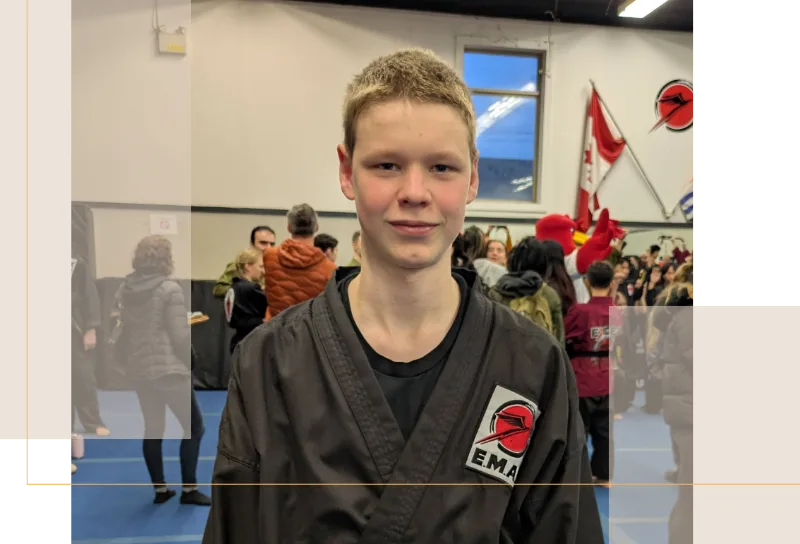
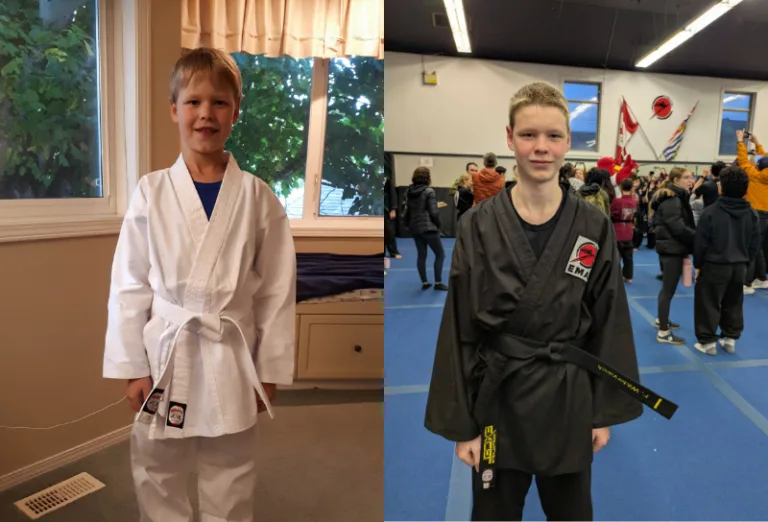
It started with a single class. During a PE session, Grade 9 Frits W. was introduced to karate, and by the time he got home, he had made up his mind. He asked his mom if he could sign up for classes, and she said yes. What followed was six years of committed, focused training that would take him to a first-degree black belt.
Those six years came in two chapters. Frits spent two years studying JKA karate before switching to Mixed Martial Arts, which he has been training in for the past 4 years. Each discipline brought its own demands, techniques, and lessons, and together they laid the foundation he needed to step up to his black belt test.
“Hard work pays off.”
This year, Frits successfully tested for his 1st degree black belt in Mixed Martial Arts in his hometown. It is the kind of achievement that doesn’t arrive by accident; it is the result of years of showing up, pushing through, and choosing the hard path because it leads somewhere worth going.
- Grounded in Success
When Frits talks about why he loves martial arts, his answer is direct and telling: “I like to challenge myself.” There’s no complicated explanation needed. For Frits, the appeal of the sport is inseparable from its difficulty; the harder it gets, the more it means.
That mindset is exactly what it takes to earn a black belt. A belt test isn’t a formality; it’s a demonstration of everything a student has absorbed over years of training: technique, discipline, composure under pressure, and the willingness to be tested and found ready. Frits met that bar.
“I like to challenge myself.”
And he isn’t done. Frits is already working toward his second-degree black belt and is also learning to become an instructor, passing on to other students the discipline and focus that have defined his own training. That combination of continuing to grow as an athlete while beginning to lead others speaks to a maturity well beyond Grade 9.
- Black Belt and Beyond
Martial arts classes don’t always run on a nine-to-five schedule. Late sessions are part of the rhythm of the sport, and for a student in a traditional school setting, that can mean early mornings after late nights, with little room to recover. For Frits, homeschooling smooths that tension out entirely.
“Sometimes classes run late, and because I homeschool I can sleep in the next morning,” he explains. That flexibility isn’t just a small convenience; it means he can train hard in the evenings without paying for it the next day. He can show up to the studio rested, focused, and ready to put in the work.
“I also have more time to practice and spend extra time at the studio refining my skills.”
That extra time at the studio is where black belts are made. Repetition, refinement, the quiet accumulation of small improvements over hundreds of hours — homeschooling gives Frits the space to do all of that without having to fit his passion around a fixed schedule. For a student who believes that hard work pays off, having more hours in the day to do that work makes all the difference.
First-degree black belt earned. Second degree in progress. Instructor training underway. Frits W. is just getting started.